
How to Calculate Percentage Off: Formula, Examples, and Sale Price
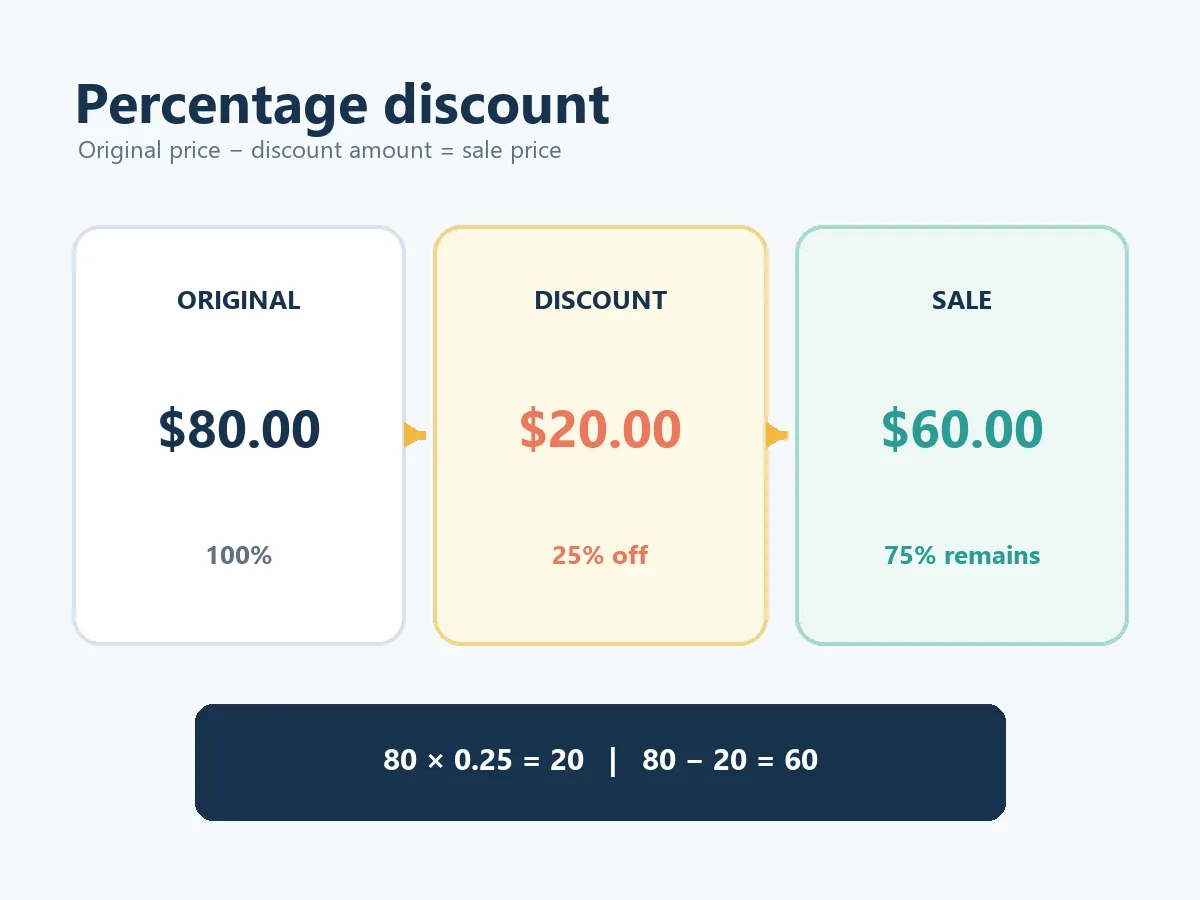
To calculate percentage off, multiply the original price by the discount rate written as a decimal. Subtract that discount amount from the original price to get the sale price. For example, 25% off $80 is a $20 discount, so the sale price is $60. This guide explains the formula, reverse discounts, stacked discounts, and spreadsheet steps without mixing up the original price and the final price.
The percentage-off formula
A percentage is a part of 100. When a store advertises “20% off,” the 20% is taken from the original or marked price, not from the price after another discount unless the offer specifically says so. Convert the percentage to a decimal by dividing it by 100, then multiply it by the original price.
Discount amount = Original price × (Discount percentage ÷ 100)
Sale price = Original price − Discount amount
You can combine the two steps into one formula: sale price = original price × (1 − discount percentage ÷ 100). With 25% off, the remaining multiplier is 0.75. This is why a $100 item becomes $75, while a $200 item becomes $150.
For a quick check, the discount amount and sale price should add back to the original price. If the original price is $80 and the discount amount is $20, then $20 + $60 = $80. This simple check catches the common mistake of subtracting the percentage number itself instead of calculating its value.
Examples with common discount rates
The same method works for 5%, 10%, 15%, 20%, 25%, or any other rate. The important input is the original price. If the original price already includes tax or shipping, keep those components separate when the seller applies the discount only to the item price.
| Original price | Discount | Discount amount | Sale price |
|---|---|---|---|
| $50 | 20% off | $10 | $40 |
| $80 | 25% off | $20 | $60 |
| $120 | 25% off | $30 | $90 |
| $200 | 15% off | $30 | $170 |
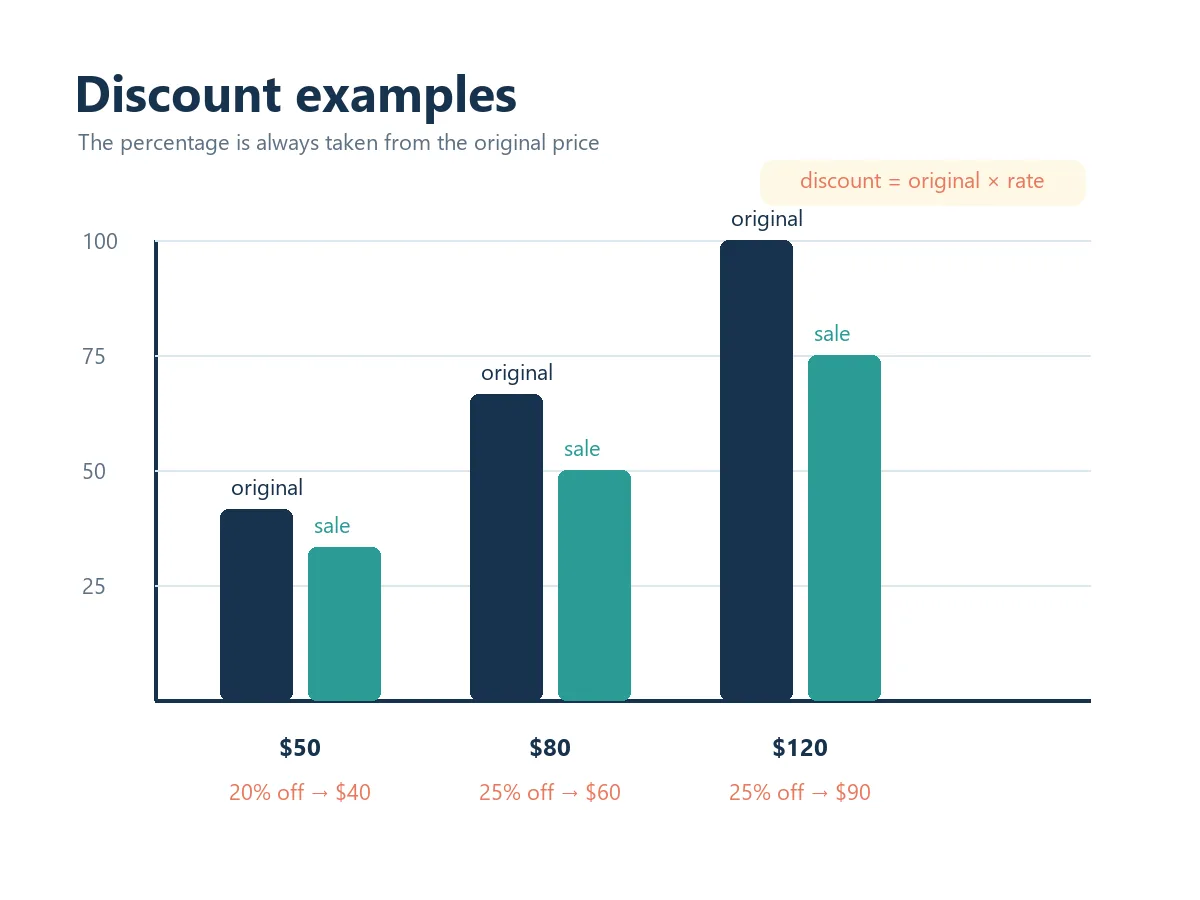
For the $120 example, calculate $120 × 25 ÷ 100 = $30, then subtract $30 from $120. The result is $90. The visual below shows why the percentage is measured against the original amount, not against the sale price.
If the result includes cents, decide how to round before comparing it with a receipt. A mathematical result of $17.995 may be displayed as $18.00, but a retailer may round at the item level, at the subtotal, or after tax. Use the seller’s stated rule for the final charge.
How to find the original price or discount rate
Finding the original price from a sale price
If you know the sale price and the discount percentage, divide the sale price by the percentage that remains. After 25% off, 75% of the original price remains, so the formula is original price = sale price ÷ 0.75. A $60 sale price divided by 0.75 gives an original price of $80.
In general, use original price = sale price ÷ (1 − discount percentage ÷ 100). This reverse calculation is undefined at 100% off because nothing remains to divide by. If the advertisement rounds the sale price, the recovered original price may also be approximate.
Finding the discount percentage from two prices
When you know the original price and the sale price, first find the dollar difference, then divide that difference by the original price. Multiply by 100 to express it as a percentage.
Discount percentage = (Original price − Sale price) ÷ Original price × 100
For an item reduced from $80 to $60, the difference is $20. The calculation is $20 ÷ $80 × 100 = 25%. Dividing by the sale price would produce 33.33%, which answers a different question and overstates the discount relative to the advertised original price.
Stacked discounts, tax, and rounding
Two discounts applied one after another are multiplied, not simply added. If an item is 20% off and then receives another 10% discount, the remaining price is 0.80 × 0.90 = 0.72 of the original. The effective discount is therefore 28%, not 30%. A $100 item becomes $72 before tax.
Taxes and shipping need a separate check. Some stores discount the item before tax, while others display tax-inclusive prices and round each line differently. Apply the discount to the amount that the offer defines, then apply tax according to the receipt or local rules. Do not assume that “25% off” means 25% off the final total when shipping, service fees, or excluded items are present.
For a general change between two values rather than a store discount, use the percentage-change formula instead. The discount formula has a clear original price as its baseline; a percentage-change calculation may describe an increase or decrease between two measurements. Keeping those baselines separate makes reports and shopping comparisons easier to interpret.
Percentage-off formulas in Excel
A spreadsheet is useful when you need to compare several products or discount rates. Put the original price in cell A2 and the discount percentage in cell B2 as a number such as 25, not 0.25.
| What you need | Excel formula | Example result |
|---|---|---|
| Discount amount | =A2*B2/100 | $20 for $80 and 25% |
| Sale price | =A2-(A2*B2/100) | $60 for $80 and 25% |
| Discount rate from sale price in C2 | =(A2-C2)/A2*100 | 25% when C2 is $60 |
| Original price from sale price in C2 | =C2/(1-B2/100) | $80 when C2 is $60 and B2 is 25 |
If you store the discount as a true Excel percentage, such as 25%, remove the /100 conversion and use =A2*B2. Add a check column such as =A2-C2 so that the displayed saving can be compared with the discount amount. If the original price is zero, the reverse rate formula cannot produce a meaningful percentage.
For a fast Japanese-language calculation, the site’s discount-rate calculator can help compare an original price and a sale price. The fixed-rate 20% off calculator is useful when the promotion rate is already known. These tools complement this article’s formulas; always check the store’s terms for exclusions and rounding.
FAQ: how to calculate percentage off
How do you calculate 10% off a price?
Multiply the original price by 0.10 to find the discount, then subtract it from the original price. For $50, the discount is $5 and the sale price is $45.
How do you calculate 20% off quickly?
Find one fifth of the original price and subtract it, or multiply the original price by 0.80. For $75, 20% off is $15, leaving $60.
How do you find the original price after a discount?
Divide the sale price by the remaining rate. After 25% off, divide by 0.75. Do not subtract the discount percentage from the sale price again.
Is percentage off the same as percentage change?
They use similar arithmetic but different context. Percentage off uses the original price as the baseline for a reduction. Percentage change compares an old value with a new value and can describe either an increase or a decrease.
Can I add two discounts together?
Usually no. Apply each discount to the price that remains. A 20% discount followed by 10% off gives an effective 28% reduction, not 30%.
Summary
The reliable way to calculate percentage off is to keep the original price as the baseline: multiply it by the discount rate to find the saving, then subtract that amount to get the sale price. For reverse problems, divide by the percentage that remains. When prices are stacked, taxed, or rounded, document the order of operations instead of assuming that the advertised percentage applies to the final total.
For a quick result, use a calculator; for repeated comparisons, use the Excel formulas above. The important habit is to label every value clearly as original price, discount amount, sale price, or discount rate.